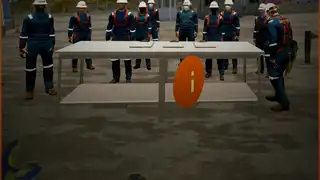
Mechanical Lifting VR Training
Master heavy rigging with immersive training. Practice overhead crane operation, forklift safety, and mobile crane lifts in VR risk-free.
Module Details
Heavy lifting operations demand absolute precision and coordination among different site roles. Utilizing high-fidelity VR immersive training systems provides a safe environment to simulate complex physics, vehicle limits, and structural constraints. This methodology bridges the gap between theoretical knowledge and field execution, allowing workforce teams to master risk assessment, clear communication handshakes, and spatial awareness without real-world hazards.
Integrating simulated workforce solutions helps logistics and construction enterprises track core performance data, steering accuracy, and compliance metrics tied to international regulatory bodies. By focusing on critical roles such as Banksman, Rigger, and Person in Charge, modern training initiatives ensure a comprehensive approach to site safety and incident reduction.
Banksman Training
Focuses on the critical role of the signaling personnel. Training parameters cover blind-spot navigation, accurate hand-gesture communication, and path calibration to guide crane operators safely around dynamic industrial floor hazards.
Rigger Training
Addresses the core responsibilities of slinging and securing loads. Key topics include structural pre-checks, dynamic hitch selection, weight distribution awareness, and standard hardware inspections before any major lift occurs.
Person in Charge (PIC)
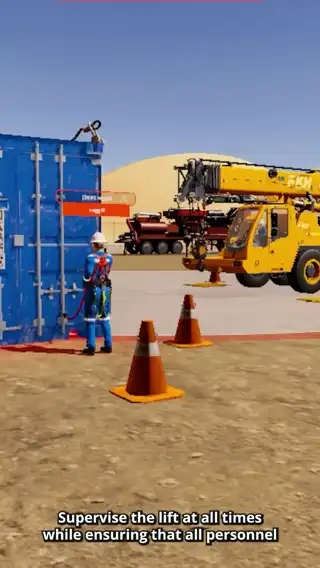
Centers on high-level lift supervision and site authority workflows. Covers complex exclusion zone management, regulatory compliance validation, emergency abort actions, and overall multi-role site coordination.
Questions
01How does VR immersive training benefit mechanical lifting operations?
It provides an interactive, risk-free setting to practice industrial logistics and heavy rigging physics. Personnel can learn to manage load dynamics, speed thresholds, and complex path coordination without the hazards or costs associated with real-world equipment failures.
02Why target specific roles like Banksman, Rigger, and PIC?
Successful lifting maneuvers rely entirely on team synchronization. Separating training frameworks into Banksman (signaling), Rigger (handling), and Person in Charge (supervision) ensures each professional understands their exact operational boundaries and joint handshakes.
03Can simulation metrics align with international safety standards?
Yes. Immersive lifting frameworks are conceptualized around strict industrial regulatory parameters, such as OSHA and ASME guidelines, focusing tracking indicators on speed violations, distance limits, and exclusion boundary compliance.