OSHA VR Training
OSHA VR training that puts crews inside the hazard — falls, lifting, fire, H2S, well control — and returns every attempt to your LMS as evidence that the practice happened.
What OSHA VR training looks like in practice
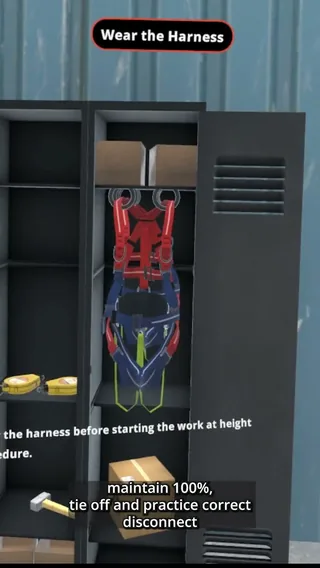
OSHA VR training is practice, not presentation. A worker puts on a headset, stands on the scaffold, fits the harness, reads the gas monitor, signals the crane or fights the fire, and the simulation responds to what they actually do — mistakes included. Every action is recorded, so a wrong anchor point becomes a coaching conversation instead of an incident report.
It suits the hazards behind most serious industrial injuries: falls from height, struck-by and caught-in events during lifting, uncontrolled energy during maintenance, and atmospheric hazards such as hydrogen sulfide. Those are the tasks hardest to rehearse for real, because doing so means taking equipment out of service or accepting risk.
- Practise the whole sequence: donning, inspecting, anchoring, signalling, escaping.
- Fail safely — a wrong anchor or a missed alarm plays out to its consequence.
- Repeat until it is automatic, with no downtime and no live hazard.
- Train in your own site layout, with your own equipment and procedures.
Every module is written from a standard
OSHA does not approve, certify or endorse training products, and no vendor can honestly claim otherwise. What TrainBeyond does is build each module from the text of the standard that governs the task, so the steps a trainee rehearses are the steps an auditor or your own HSE team would look for.
Height modules come from the construction fall protection rules and the general industry walking-working surfaces rules; rigging, signalling and lifting from the crane and rigging equipment requirements; H2S from respiratory protection with ANSI/ASSP Z390.1. Where OSHA has no standard of its own — well control, for instance — modules follow OSHA's well drilling guidance with API Standard 53 and API RP 54. The table below gives the detail.
Documenting practice for audits
Training you cannot evidence is training you will be asked to do again. Every attempt produces a record: who trained, on which module, when, how long it took, which steps were correct and where the run went wrong. Those records leave the headset over LTI 1.3 and land in your own learning management system.
For an organisation running ISO 45001, the same records support the competence and awareness clauses. They help document practice against the standards below — they do not replace the hands-on, site-specific training the employer must provide.
- Per-attempt records: learner, module, date, duration, score and step-level results.
- Delivered to your LMS over LTI 1.3, with single sign-on from existing accounts.
- Repeat attempts tracked separately, so improvement over time is visible.
- Evidence for internal audits, client pre-qualification and ISO 45001 reviews.
Who it is for
HSE managers use it to close the gap between a signed attendance sheet and demonstrated competence. Training coordinators run the same exercise across shifts, sites and languages without booking a rig, a crane or a burn pit. Contractors use it to show a client that a crew rehearsed the hazard before mobilising — in oil and gas, construction, chemicals, manufacturing and logistics.
- HSE and safety managers responsible for competence and audit evidence.
- Training coordinators and L&D teams running programmes across several sites.
- Contractors and service companies facing client pre-qualification.
- Supervisors, permit holders and persons in charge of lifting operations.
Runs on Meta Quest, desktop and mobile
The same module runs on Meta Quest for full room-scale immersion, on desktop for classroom and remote delivery, and on mobile for a refresher before the job. Immersive VR training is the deepest version, but nobody is left out because the headsets are in another region.
None of it carries real-life risk: no live load, no ignition source, no hydrocarbon, no work at height. Rollout takes days rather than months, and the environments are modelled on your site, in the languages your crews speak. Level up your workforce.
- Meta Quest for room-scale, hands-on practice.
- Desktop for classrooms, inductions and toolbox talks.
- Mobile for refreshers and pre-job reminders.
- Multi-language delivery, with no travel to a training centre.
Questions
01What is OSHA VR training?
Virtual reality practice of a safety-critical task, built from the text of the OSHA standard that governs it. Instead of watching a presentation on fall clearance or gas detection, the worker performs the sequence in a simulated worksite while every step is recorded.
02Which standards do the modules map to?
The table on this page pairs each standard with its modules: fall protection and walking-working surfaces for height, cranes and rigging for lifting, HAZWOPER and respiratory protection for gas and spills, fire extinguishers and emergency action plans for the emergency modules, lockout/tagout for pipe cutting, and API Standard 53 with API RP 54 for well control.
03How do results reach our LMS?
Over LTI 1.3. TrainBeyond launches from your LMS as an external tool, the learner signs in with their existing account, and each attempt returns a score and completion record with step-level detail.
04How does OSHA VR training stand up to an audit?
Each module is written from a named standard, supports compliance with the topics that standard covers, and leaves per-attempt evidence you can produce on request. One point worth stating plainly: OSHA does not approve, certify or endorse training products, courses or vendors from anyone, so treat any claim to the contrary as a warning sign. What you can document is the training you delivered, and that is what the records are for.
05How does it fit alongside the hands-on training we already run?
Most customers use it as the repeatable practice and assessment layer: a worker rehearses the full sequence as many times as it takes, and every attempt is recorded as evidence. It sits alongside instructor-led sessions rather than replacing them — the employer remains responsible for meeting the applicable standards, including any hands-on component and site-specific instruction.
Standards each module is written from
Every module is written from the standard it maps to, so the exercise doubles as the documented practice that standard expects.
OSHA does not approve, certify or endorse training products from any provider.